<?xml version="1.0" encoding="utf-8" ?>
<rdf:RDF xmlns:rdf="http://www.w3.org/1999/02/22-rdf-syntax-ns#" xmlns:dc="http://purl.org/dc/elements/1.1/" xmlns:syn="http://purl.org/rss/1.0/modules/syndication/" xmlns="http://purl.org/rss/1.0/">


<channel rdf:about="http://www.dm.unife.it/it/search_rss">
  <title>Dipartimento di Matematica e Informatica</title>
  <link>http://www.dm.unife.it</link>

  <description>
    
            These are the search results for the query, showing results 186 to 200.
        
  </description>


  <image rdf:resource="http://www.dm.unife.it/logo.png"/>

  <items>
    <rdf:Seq>
      
        <rdf:li rdf:resource="http://www.dm.unife.it/it/eventi/high-order-estimates-for-fully-nonlinear-second-order-equations-under-weak-concavity-assumptions"/>
      
      
        <rdf:li rdf:resource="http://www.dm.unife.it/it/eventi/ciclo-di-conferenze-201cle-difficolta-in-matematica-all2019universita-e-nel-passaggio-scuola-secondaria-di-secondo-grado-universita.201d"/>
      
      
        <rdf:li rdf:resource="http://www.dm.unife.it/it/risorse/events/synchronization-of-kuramoto-oscillators-with-adaptive-couplings-jinyeong-park-seoul-national-university"/>
      
      
        <rdf:li rdf:resource="http://www.dm.unife.it/it/risorse/events/thom-class-and-the-riemann-roch-theorem-t-suwa-hokkaido-university"/>
      
      
        <rdf:li rdf:resource="http://www.dm.unife.it/it/risorse/events/seminario-reasoning-in-interval-temporal-logics-guido-sciavicco"/>
      
      
        <rdf:li rdf:resource="http://www.dm.unife.it/it/eventi/seminari-di-analisi-unife"/>
      
      
        <rdf:li rdf:resource="http://www.dm.unife.it/it/eventi/ciclo-di-seminari-di-formazione-di-didattica-della-matematica"/>
      
      
        <rdf:li rdf:resource="http://www.dm.unife.it/it/eventi/didattica-della-matematica-a-distanza-1deg-incontro"/>
      
      
        <rdf:li rdf:resource="http://www.dm.unife.it/it/eventi/interactive-workshop-on-hyperbolic-equations"/>
      
      
        <rdf:li rdf:resource="http://www.dm.unife.it/it/eventi/workshop-fourier-analysis-and-partial-differential-equations"/>
      
      
        <rdf:li rdf:resource="http://www.dm.unife.it/it/eventi/galois-theory-from-groups-and-forms-to-descent-theory-and-extensions"/>
      
      
        <rdf:li rdf:resource="http://www.dm.unife.it/it/eventi/infty-harmonic-potentials-in-convex-rings-erik-lindgren"/>
      
      
        <rdf:li rdf:resource="http://www.dm.unife.it/it/risorse/events/seminario-agora-matematico"/>
      
      
        <rdf:li rdf:resource="http://www.dm.unife.it/it/eventi/tba-stefano-bonaccorsi-universita-di-trento"/>
      
      
        <rdf:li rdf:resource="http://www.dm.unife.it/it/eventi/problemi-di-optimal-design-per-energie-a-crescita-non-standard-elvira-zappale"/>
      
    </rdf:Seq>
  </items>

</channel>


  <item rdf:about="http://www.dm.unife.it/it/eventi/high-order-estimates-for-fully-nonlinear-second-order-equations-under-weak-concavity-assumptions">
    <title>High-order estimates for fully nonlinear second order equations under weak concavity assumptions</title>
    <link>http://www.dm.unife.it/it/eventi/high-order-estimates-for-fully-nonlinear-second-order-equations-under-weak-concavity-assumptions</link>
    <description>Seminario di Alessandro Goffi (Università di Padova)</description>
    <content:encoded xmlns:content="http://purl.org/rss/1.0/modules/content/"><![CDATA[<div></div>
<div>Abstract:</div>
<p><span>In  1982 L.C. Evans and N.V. Krylov proved interior a priori second  derivatives estimates in Hölder spaces for fully nonlinear second  order  uniformly elliptic equations under the main assumption that  the  operator is either concave or convex in the Hessian variable.  Since  then, a remarkable question in the theory is to determine which  hypotheses on the operator in between convexity/concavity and no  assumptions ensure that solutions to general second  order fully  nonlinear equations are classical. In this direction, N. Nadirashvili  and  S. Vladut exhibited counterexamples in dimension higher than or  equal  to 5 to show that the sole uniform ellipticity is in general  not  enough to reach classical regularity. Despite this progress,  the  minimal assumptions guaranteeing classical regularity are unknown,  and  the above question has remained largely open.</span><span><br /></span><span>After  a review of the regularity theory for fully nonlinear  equations, I  will discuss some advances on the Evans-Krylov theory and show how to  prove interior  C^{2,alpha} and C^{1,1} regularity for elliptic and  parabolic problems  under the assumption that the operator is  quasi-concave/convex. I will also consider interior estimates for  functionals that are concave/convex or “close to a hyperplane”  at  infinity as well as C^{2,alpha} parabolic regularity in dimension 3  or under Cordes assumptions on the ellipticity. The approach is based  on  linearization arguments and Bernstein methods.  I will conclude with  some consequences about the Calderón-Zygmund regularity of solutions to  (fully nonlinear) second order Hamilton-Jacobi-Bellman/Isaacs equations  with power-growth gradient terms and discuss the relation with  a conjecture posed by P.-L. Lions.</span></p>
<p> </p>]]></content:encoded>
    <dc:publisher>No publisher</dc:publisher>
    <dc:creator>Rizzati Michele</dc:creator>
    <dc:rights></dc:rights>
    
      <dc:subject>seminario</dc:subject>
    
    
      <dc:subject>dipartimento</dc:subject>
    
    
      <dc:subject>convegno</dc:subject>
    
    <dc:date>2024-05-08T14:04:53Z</dc:date>
    <dc:type>Evento</dc:type>
  </item>


  <item rdf:about="http://www.dm.unife.it/it/eventi/ciclo-di-conferenze-201cle-difficolta-in-matematica-all2019universita-e-nel-passaggio-scuola-secondaria-di-secondo-grado-universita.201d">
    <title>Ciclo di conferenze: “Le difficoltà in matematica all’università e nel passaggio scuola secondaria di secondo grado - università.”</title>
    <link>http://www.dm.unife.it/it/eventi/ciclo-di-conferenze-201cle-difficolta-in-matematica-all2019universita-e-nel-passaggio-scuola-secondaria-di-secondo-grado-universita.201d</link>
    <description>Conferenza in presenza</description>
    <content:encoded xmlns:content="http://purl.org/rss/1.0/modules/content/"><![CDATA[<p><span dir="ltr">Il 23 maggio 2022, dalle ore 14.30 alle ore 16.30</span><span dir="ltr"> presso il Dipartimento di</span><span dir="ltr"> </span><span dir="ltr">Matematica</span><span dir="ltr"> </span><span dir="ltr">e</span><span dir="ltr"> </span><span dir="ltr">Informatica, Università di Ferrara</span><span dir="ltr"> </span><span dir="ltr">-</span><span dir="ltr"> </span><span dir="ltr">via</span><span dir="ltr"> Machiavelli 30, Ferrara </span><span dir="ltr"> </span><br /><span dir="ltr"> </span></p>
<p>si terrà il terzo e ultimo incontro del Ciclo di conferenze: "Le  difficoltà in matematica all'università e nel passaggio scuola  secondaria di secondo grado - università".</p>
<p> </p>
<div>L'incontro avrà per titolo: “Esempi e controesempi, questi   sconosciuti" e sarà tenuto dal Prof. Samuele Antonini dell'Università di   Firenze.</div>
<div>Si svolgerà lunedì 23 maggio 2022 dalle ore 14.30 alle ore  16.30  in presenza presso  il Dipartimento di Matematica e Informatica   dell'Università di Ferrara.</div>
<div></div>
<div>
<div></div>
<div>Sarà possibile seguire l'evento anche in diretta streaming su Google Meet al seguente link:</div>
<div></div>
<div>
<p><a href="http://meet.google.com/eib-site-bfu" target="_blank">meet.google.com/eib-site-bfu</a></p>
</div>
</div>
<div></div>
<p><span dir="ltr">Per</span><span dir="ltr"> </span><span dir="ltr">partecipare</span><span dir="ltr"> </span><span dir="ltr">è</span><span dir="ltr"> </span><span dir="ltr">necessario</span><span dir="ltr"> </span><span dir="ltr">iscriversi</span><span dir="ltr"> </span><span dir="ltr">al</span><span dir="ltr"> </span><span dir="ltr">seguente</span><span dir="ltr"> </span><span dir="ltr">modulo</span><span dir="ltr">:</span><br /><span dir="ltr">https://</span><span dir="ltr">forms.gle</span><span dir="ltr">/h3B1rHnRvUKadHVN9</span><br /><span dir="ltr"><br /></span></p>
<p><span dir="ltr"><span dir="ltr">Processi</span><span dir="ltr"> </span><span dir="ltr">importanti</span><span dir="ltr"> </span><span dir="ltr">in</span><span dir="ltr"> </span><span dir="ltr">diverse</span><span dir="ltr"> </span><span dir="ltr">attività</span><span dir="ltr"> </span><span dir="ltr">matematiche</span><span dir="ltr"> </span><span dir="ltr">sono</span><span dir="ltr"> </span><span dir="ltr">quelli</span><span dir="ltr"> </span><span dir="ltr">che</span><span dir="ltr"> </span><span dir="ltr">portano</span><span dir="ltr"> </span><span dir="ltr">alla</span><span dir="ltr"> costruzione</span><span dir="ltr"> </span><span dir="ltr">di</span><span dir="ltr"> </span><span dir="ltr">esempi</span><span dir="ltr"> </span><span dir="ltr">e</span><span dir="ltr"> </span><span dir="ltr">controesempi</span><span dir="ltr">.</span><span dir="ltr"> </span><span dir="ltr">L’apprendimento</span><span dir="ltr"> </span><span dir="ltr">di</span><span dir="ltr"> </span><span dir="ltr">nuovi</span><span dir="ltr"> </span><span dir="ltr">concetti,</span><span dir="ltr"> l’esplorazione</span><span dir="ltr"> </span><span dir="ltr">di</span><span dir="ltr"> </span><span dir="ltr">un</span><span dir="ltr"> </span><span dir="ltr">problema,</span><span dir="ltr"> </span><span dir="ltr">la</span><span dir="ltr"> </span><span dir="ltr">produzione</span><span dir="ltr"> </span><span dir="ltr">di</span><span dir="ltr"> </span><span dir="ltr">una</span><span dir="ltr"> </span><span dir="ltr">congettura</span><span dir="ltr"> </span><span dir="ltr">e</span><span dir="ltr"> </span><span dir="ltr">di</span><span dir="ltr"> </span><span dir="ltr">una</span><span dir="ltr"> </span><span dir="ltr">dimostrazione</span><span dir="ltr"> e</span><span dir="ltr"> </span><span dir="ltr">tante</span><span dir="ltr"> </span><span dir="ltr">altre</span><span dir="ltr"> </span><span dir="ltr">situazioni</span><span dir="ltr"> </span><span dir="ltr">richiedono</span><span dir="ltr"> </span><span dir="ltr">una</span><span dir="ltr"> </span><span dir="ltr">certa</span><span dir="ltr"> </span><span dir="ltr">familiarità</span><span dir="ltr"> </span><span dir="ltr">con</span><span dir="ltr"> </span><span dir="ltr">gli</span><span dir="ltr"> </span><span dir="ltr">oggetti</span><span dir="ltr"> </span><span dir="ltr">matematici</span><span dir="ltr">.</span><br /><span dir="ltr">Tuttavia,</span><span dir="ltr"> </span><span dir="ltr">è</span><span dir="ltr"> </span><span dir="ltr">possibile</span><span dir="ltr"> </span><span dir="ltr">notare</span><span dir="ltr"> </span><span dir="ltr">uno</span><span dir="ltr"> </span><span dir="ltr">scollamento</span><span dir="ltr"> </span><span dir="ltr">nella</span><span dir="ltr"> </span><span dir="ltr">conoscenza</span><span dir="ltr"> </span><span dir="ltr">degli</span><span dir="ltr"> </span><span dir="ltr">studenti</span><span dir="ltr"> </span><span dir="ltr">di</span><span dir="ltr"> </span><span dir="ltr">tutti</span><span dir="ltr"> </span><span dir="ltr">i</span><span dir="ltr"> livelli</span><span dir="ltr"> </span><span dir="ltr">scolari,</span><span dir="ltr"> </span><span dir="ltr">compreso</span><span dir="ltr"> </span><span dir="ltr">quello</span><span dir="ltr"> </span><span dir="ltr">universitario,</span><span dir="ltr"> </span><span dir="ltr">tra</span><span dir="ltr"> </span><span dir="ltr">la</span><span dir="ltr"> </span><span dir="ltr">conoscenza</span><span dir="ltr"> </span><span dir="ltr">di</span><span dir="ltr"> </span><span dir="ltr">procedure,</span><span dir="ltr"> </span><span dir="ltr">la</span><span dir="ltr"> conoscenza</span><span dir="ltr"> </span><span dir="ltr">di</span><span dir="ltr"> </span><span dir="ltr">teoremi,</span><span dir="ltr"> </span><span dir="ltr">dimostrazioni</span><span dir="ltr"> </span><span dir="ltr">e</span><span dir="ltr"> </span><span dir="ltr">definizioni</span><span dir="ltr"> </span><span dir="ltr">e</span><span dir="ltr"> </span><span dir="ltr">la</span><span dir="ltr"> </span><span dir="ltr">competenza,</span><span dir="ltr"> </span><span dir="ltr">che</span><span dir="ltr"> </span><span dir="ltr">risulta</span><span dir="ltr"> particolarmente</span><span dir="ltr"> </span><span dir="ltr">fragile,</span><span dir="ltr"> </span><span dir="ltr">nel</span><span dir="ltr"> </span><span dir="ltr">costruire</span><span dir="ltr"> </span><span dir="ltr">esempi</span><span dir="ltr"> </span><span dir="ltr">e</span><span dir="ltr"> </span><span dir="ltr">controesempi</span><span dir="ltr">.</span><span dir="ltr"> </span><span dir="ltr">L’incontro</span><span dir="ltr"> </span><span dir="ltr">verterà</span><span dir="ltr"> </span><span dir="ltr">su</span><span dir="ltr"> questi</span><span dir="ltr"> </span><span dir="ltr">temi,</span><span dir="ltr"> </span><span dir="ltr">con</span><span dir="ltr"> </span><span dir="ltr">particolare</span><span dir="ltr"> </span><span dir="ltr">riferimento</span><span dir="ltr"> </span><span dir="ltr">ad</span><span dir="ltr"> </span><span dir="ltr">aspetti</span><span dir="ltr"> </span><span dir="ltr">legati</span><span dir="ltr"> </span><span dir="ltr">alle</span><span dir="ltr"> </span><span dir="ltr">definizioni</span><span dir="ltr"> </span><span dir="ltr">e</span><span dir="ltr"> </span><span dir="ltr">alle</span><span dir="ltr"> dimostrazioni</span><span dir="ltr">.</span></span></p>]]></content:encoded>
    <dc:publisher>No publisher</dc:publisher>
    <dc:creator>Rizzati Michele</dc:creator>
    <dc:rights></dc:rights>
    
      <dc:subject>seminario</dc:subject>
    
    
      <dc:subject>dipartimento</dc:subject>
    
    
      <dc:subject>convegno</dc:subject>
    
    <dc:date>2022-05-19T10:40:02Z</dc:date>
    <dc:type>Evento</dc:type>
  </item>


  <item rdf:about="http://www.dm.unife.it/it/risorse/events/synchronization-of-kuramoto-oscillators-with-adaptive-couplings-jinyeong-park-seoul-national-university">
    <title>Synchronization of Kuramoto oscillators with adaptive couplings -  Jinyeong Park (Seoul National University)</title>
    <link>http://www.dm.unife.it/it/risorse/events/synchronization-of-kuramoto-oscillators-with-adaptive-couplings-jinyeong-park-seoul-national-university</link>
    <description></description>
    <content:encoded xmlns:content="http://purl.org/rss/1.0/modules/content/"><![CDATA[<p>We study the synchronization of Kuramoto  oscillators with adaptive coupling in interacting networks.</p>
<p>Network  dynamics preserves the sum of all incoming pairwise coupling strengths  and is designed to adaptively interact with system dynamics.For  adaptive couplings, we use two adaptive coupling laws for the pairwise  coupling strength. Kuramoto oscillators are assumed to be on the nodes  of the networks.</p>
<p> </p>
<p>We present frameworks that guarantee the emergence of  synchronization for various coupling feedback laws. Our results  generalize earlier work on the synchronization of Kuramoto oscillators  in fixed and symmetric networks.</p>]]></content:encoded>
    <dc:publisher>No publisher</dc:publisher>
    <dc:creator>Stumbo Fabio</dc:creator>
    <dc:rights></dc:rights>
    
      <dc:subject>seminario</dc:subject>
    
    <dc:date>2016-04-23T13:30:54Z</dc:date>
    <dc:type>Evento</dc:type>
  </item>


  <item rdf:about="http://www.dm.unife.it/it/risorse/events/thom-class-and-the-riemann-roch-theorem-t-suwa-hokkaido-university">
    <title>Thom Class and the Riemann-Roch Theorem - T. Suwa (Hokkaido University)</title>
    <link>http://www.dm.unife.it/it/risorse/events/thom-class-and-the-riemann-roch-theorem-t-suwa-hokkaido-university</link>
    <description></description>
    <content:encoded xmlns:content="http://purl.org/rss/1.0/modules/content/"><![CDATA[<p><b>Abstract: </b><br /><br />The Thom class of a complex vector bundle is a characteristic</p>
<div>class that contains, in some sense, more information than</div>
<div>the Chern class does. I give an expression of the Thom class in</div>
<div>the relative de Rham cohomology and show how this can be used</div>
<div>to prove a "universal Riemann-Roch theorem for embeddings".</div>
<div class="gmail-ajU gmail-yj6qo">
<div class="gmail-ajR" id="gmail-:1rp"><img class="gmail-ajT" src="https://ssl.gstatic.com/ui/v1/icons/mail/images/cleardot.gif" /></div>
</div>]]></content:encoded>
    <dc:publisher>No publisher</dc:publisher>
    <dc:creator>Stumbo Fabio</dc:creator>
    <dc:rights></dc:rights>
    
      <dc:subject>seminario</dc:subject>
    
    <dc:date>2016-09-20T15:12:13Z</dc:date>
    <dc:type>Evento</dc:type>
  </item>


  <item rdf:about="http://www.dm.unife.it/it/risorse/events/seminario-reasoning-in-interval-temporal-logics-guido-sciavicco">
    <title>Seminario: Reasoning in Interval Temporal Logics (Guido Sciavicco)</title>
    <link>http://www.dm.unife.it/it/risorse/events/seminario-reasoning-in-interval-temporal-logics-guido-sciavicco</link>
    <description></description>
    <content:encoded xmlns:content="http://purl.org/rss/1.0/modules/content/"><![CDATA[<h2><span style="text-align: start; float: none; ">Reasoning in Interval Temporal Logics</span></h2>
<p>Prof. <span style="text-align: start; float: none; ">Guido Sciavicco, <span style="text-align: start; float: none; ">Università di Murcia - Spagna</span></span></p>
<p> </p>
<p><span style="text-align: start; float: none; ">In this talk I will survey the most important aspects in automated reasoning over temporal logics, and in particular interval-based ones - ITLs. In ITLs properties are defined over extended intervals of time, instead of points, giving rise to a huge variety of syntactical as well as semantical possibilities. While reasoning in ITLs is generally very difficult, as their satisfiability problems are often undecidable, I will focus on those interesting exceptions that have been found in the last 15 years of research, and try to point out the different ideas and stratiegies that have been proven useful in searching for computationally well-behaved ITLs. I will also try to give a sufficiently clear idea on how ITLs can be applied, and how the research in this sense is still very much active.</span></p>]]></content:encoded>
    <dc:publisher>No publisher</dc:publisher>
    <dc:creator>Ferrari Michele</dc:creator>
    <dc:rights></dc:rights>
    
      <dc:subject>seminario</dc:subject>
    
    <dc:date>2015-04-07T09:33:11Z</dc:date>
    <dc:type>Evento</dc:type>
  </item>


  <item rdf:about="http://www.dm.unife.it/it/eventi/seminari-di-analisi-unife">
    <title>Seminari di Analisi @ Unife - The effects of flux-saturated diffusion on indefinite logistic-growth models</title>
    <link>http://www.dm.unife.it/it/eventi/seminari-di-analisi-unife</link>
    <description>Seminario su Google Meet </description>
    <content:encoded xmlns:content="http://purl.org/rss/1.0/modules/content/"><![CDATA[<p>Giovedì 13 maggio 2021<br /> Ore 16.00<br /> Elisa Sovrano (EHESS-CAMS-CNRS Paris)<br /> <br /> Title: <br /> The effects of flux-saturated diffusion on indefinite logistic-growth models<br /> <br /> Abstract: <br /> Reaction-diffusion processes can be based on Fick-Fourier's law.  Changing perspective, we deal with a dispersive flux which is a  nonlinear bounded function of the gradient. In a bounded domain with a  regular boundary, we investigate a Dirichlet problem associated with a  quasilinear reaction-diffusion equation where the mean curvature  operator drives the diffusion process. As for the reaction, we consider  the product of a logistic-type nonlinearity and a sign-changing weight  function modeling spatial heterogeneities. For this problem, we present  some recent results concerning the existence and the multiplicity of  positive solutions. Depending on the logistic term's behavior at zero,  we prove three qualitatively different bifurcation diagrams by varying  the diffusivity parameter. We point out a new multiplicity phenomenon  without any similarity with the case of linear-diffusion logistic-growth  models. <br /> This talk is based on joint works with Pierpaolo Omari (University of Trieste).</p>
<p> </p>
<p>Il seminario si terra’ in modalità’ telematica e il codice meet per collegarsi e’:<br /><br /><a class="external-link" href="https://meet.google.com/dif-qrmm-bgy">https://meet.google.com/dif-qrmm-bgy</a></p>]]></content:encoded>
    <dc:publisher>No publisher</dc:publisher>
    <dc:creator>Rizzati Michele</dc:creator>
    <dc:rights></dc:rights>
    
      <dc:subject>seminario</dc:subject>
    
    <dc:date>2021-05-11T10:43:21Z</dc:date>
    <dc:type>Evento</dc:type>
  </item>


  <item rdf:about="http://www.dm.unife.it/it/eventi/ciclo-di-seminari-di-formazione-di-didattica-della-matematica">
    <title>Ciclo di seminari di Formazione di Didattica della Matematica</title>
    <link>http://www.dm.unife.it/it/eventi/ciclo-di-seminari-di-formazione-di-didattica-della-matematica</link>
    <description>Per docenti del primo e secondo ciclo di istruzione</description>
    <content:encoded xmlns:content="http://purl.org/rss/1.0/modules/content/"><![CDATA[<h3>Prima parte:</h3>
<p><b>14 NOVEMBRE 2023</b> DALLE 17:00 ALLE 18:30    <br />BRUNO D’AMORE  -  Universidad Francisco José de Caldas, Bogotá<br />Le basi della didattica della matematica</p>
<p><b>29 NOVEMBRE 2023</b> DALLE 17:00 ALLE 18:30    <br />GIORGIO BOLONDI  -  Libera Università di Bolzano<br />Le competenze linguistiche nell'apprendimento della matematica<br /><br /><b>11 DICEMBRE 2023</b> DALLE 17:00 ALLE 18:30<br />PIETRO DI MARTINO   - Università di Pisa<br />Il problem solving come elemento centrale dell’educazione matematica</p>
<p> </p>
<h3>Seconda parte:</h3>
<p>Il ciclo di seminari riprenderà da febbraio 2024 e i relatori saranno Fabio Brunelli, Antonella Castellini, Agnese Del Zozzo, Alice Lemmo,Francesca Martignone, George Santi</p>
<p> </p>
<p>GLI INCONTRI SI SVOLGERANNO PRESSO IL DIPARTIMENTO DI MATEMATICA E INFORMATICADELL’UNIVERSITÀ DI FERRARA<br />SARÀ POSSIBILE PARTECIPARE AGLI INCONTRI SIA IN PRESENZA SIA DA REMOTO.</p>
<p> </p>
<p>Per iscriversi è necessario compilare il seguente modulo:<br /><span><a class="external-link" href="https://forms.gle/VLNKHvV3bfzF4MEG6">https://forms.gle/VLNKHvV3bfzF4MEG6</a></span></p>
<p> </p>
<p> </p>
<p><span><a href="http://www.dm.unife.it/it/eventi/Ciclo%20seminari%20unife.pdf/at_download/file" type="application/pdf" class="internal-link internal-link-tofile" title="pdf, 562.1 KB">Scarica il volantino<br /></a></span></p>]]></content:encoded>
    <dc:publisher>No publisher</dc:publisher>
    <dc:creator>Rizzati Michele</dc:creator>
    <dc:rights></dc:rights>
    
      <dc:subject>seminario</dc:subject>
    
    
      <dc:subject>dipartimento</dc:subject>
    
    
      <dc:subject>convegno</dc:subject>
    
    
      <dc:subject>orientamento</dc:subject>
    
    <dc:date>2023-10-11T15:02:50Z</dc:date>
    <dc:type>Evento</dc:type>
  </item>


  <item rdf:about="http://www.dm.unife.it/it/eventi/didattica-della-matematica-a-distanza-1deg-incontro">
    <title>Didattica della matematica a distanza - 1° incontro</title>
    <link>http://www.dm.unife.it/it/eventi/didattica-della-matematica-a-distanza-1deg-incontro</link>
    <description>Webinar di: DIDATTICA DELLA MATEMATICA</description>
    <content:encoded xmlns:content="http://purl.org/rss/1.0/modules/content/"><![CDATA[<p>Titolo:  <i><b>Didattica della matematica a distanza  - 1° incontro</b></i><br /><br />Relatore: Dott.ssa Federica <b>FERRETTI</b> (Università di Bolzano - Università di Bologna)<br /><br />Data e ora: <b>Mercoledì 22 aprile 2020 ore 15</b>.<br /><br /><br /> <b>Abstract</b>: Primo  incontro del ciclo dei seminari sulla <i>Didattica della matematica a distanza. <br /></i><i>O</i>ltre  a riflessioni inerenti la didattica e la  valutazione a distanza, verranno presentati e analizzati dei video di  sequenze didattiche che saranno resi disponibili gratuitamente a tutti i  partecipanti. La prima parte riguarderà aspetti generali della  didattica della matematica a distanza, mentre la seconda sarà  indirizzata al I ciclo di istruzione. Seguirà un analogo incontro,  dedicato principalmente al II ciclo</p>
<p><br /> <b>Collegamento</b>: <br />Per connettersi al webinar è necessario iscriversi al seguente link e completare i brevi passi richiesti per la registrazione:</p>
<p><i>You are invited to a Zoom meeting. </i></p>
<p><i>When: Apr 22, 2020 15:00 Rome </i></p>
<p><i> </i></p>
<p><i>Register in advance for this meeting:</i></p>
<p><i><a href="https://zoom.us/meeting/register/tJwuduyhrDsuE9bputj2i-3rYyiikvrgtuFl" target="_blank">https://zoom.us/meeting/register/tJwuduyhrDsuE9bputj2i-3rYyiikvrgtuFl</a></i></p>
<p><i> </i></p>
<p><i>After registering, you will receive a confirmation email containing information about joining the meeting.</i></p>
<p><br /><br /><b>Contatto di riferimento</b>: Maria Teresa BORGATO<br /> <br /><br /></p>]]></content:encoded>
    <dc:publisher>No publisher</dc:publisher>
    <dc:creator>Rizzati Michele</dc:creator>
    <dc:rights></dc:rights>
    
      <dc:subject>seminario</dc:subject>
    
    <dc:date>2020-04-20T09:56:56Z</dc:date>
    <dc:type>Evento</dc:type>
  </item>


  <item rdf:about="http://www.dm.unife.it/it/eventi/interactive-workshop-on-hyperbolic-equations">
    <title>Interactive workshop on hyperbolic equations</title>
    <link>http://www.dm.unife.it/it/eventi/interactive-workshop-on-hyperbolic-equations</link>
    <description>Convegno di Analisi matematica</description>
    <content:encoded xmlns:content="http://purl.org/rss/1.0/modules/content/"><![CDATA[<p>Il Dipartimento di Matematica e Informatica organizza un convegno presso la sua sede in via Machiavelli 30 nei giorni 10-12 settembre 2018 dal titolo “Interactive workshop on hyperbolic differential equations”.</p>
<p>Il workshop riunirà alcuni giovani ricercatori, in larga parte italiani e post-doc, impegnati in ricerche scientifiche concernenti le equazioni alle derivate parziali non lineari di tipo iperbolico, sia dal punto di vista analitico che dal punto di vista numerico. Sono previsti dodici relatori "giovani". A questi si affiancheranno quattro relatori "esperti", che terranno seminari di ampio respiro sul tema del workshop. Lo scopo è quello di creare uno spazio per l'interazione effettiva dei partecipanti; i quattro esperti, in particolare, cercheranno di stimolare la partecipazione dei giovani in merito ad ogni singolo seminario. Nel rispetto della parità di genere: due dei quattro relatori “esperti” saranno donne, così come sei dei giovani relatori.</p>
<p> </p>
<p>Il Comitato scientifico e gli organizzatori locali sono:</p>
<p>A. Corli (Università di Ferrara, Italia)</p>
<p>M. D. Rosini (Università di Ferrara, Italia)</p>]]></content:encoded>
    <dc:publisher>No publisher</dc:publisher>
    <dc:creator>Marangon Sara</dc:creator>
    <dc:rights></dc:rights>
    
      <dc:subject>seminario</dc:subject>
    
    
      <dc:subject>convegno</dc:subject>
    
    <dc:date>2018-09-06T14:09:18Z</dc:date>
    <dc:type>Evento</dc:type>
  </item>


  <item rdf:about="http://www.dm.unife.it/it/eventi/workshop-fourier-analysis-and-partial-differential-equations">
    <title>Workshop "Fourier Analysis and Partial Differential Equations"</title>
    <link>http://www.dm.unife.it/it/eventi/workshop-fourier-analysis-and-partial-differential-equations</link>
    <description>Convegno di Analisi matematica</description>
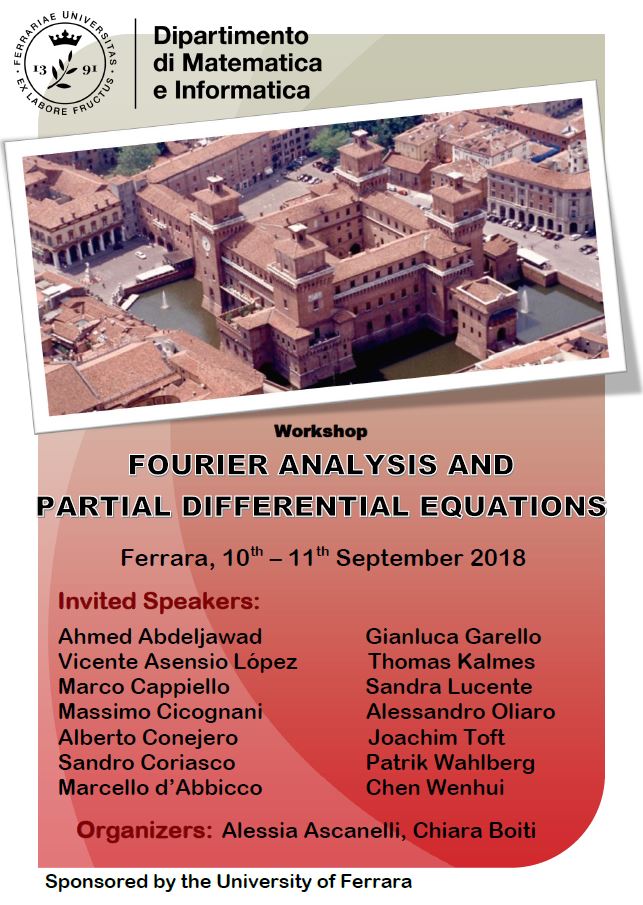
    <content:encoded xmlns:content="http://purl.org/rss/1.0/modules/content/"><![CDATA[<p>Il Dipartimento di Matematica e Informatica organizza un convegno presso la sua sede in via Machiavelli 30 nei giorni 10-11 settembre 2018 dal titolo “Fourier Analysis and Partial Differential Equations”.</p>
<p>Questo convegno ha lo scopo di riunire giovani scienziati ed esperti internazionali nell'ambito delle equazioni  differenziali alle derivate parziali ed in particolare degli operatori pseudo-differenziali e dell'analisi di Fourier.</p>
<p>Il Comitato scientifico e organizzativo: A. Ascanelli, C. Boiti</p>
<p><a href="http://www.dm.unife.it/it/eventi/NewProgramFE2018.pdf/at_download/file" type="application/pdf" class="internal-link internal-link-tofile" title="pdf, 160.0 KB">Programma</a></p>
<p> </p>
<p><img src="http://www.dm.unife.it/it/eventi/fourier.JPG" alt="" class="image-inline" title="" /></p>]]></content:encoded>
    <dc:publisher>No publisher</dc:publisher>
    <dc:creator>Marangon Sara</dc:creator>
    <dc:rights></dc:rights>
    
      <dc:subject>seminario</dc:subject>
    
    
      <dc:subject>convegno</dc:subject>
    
    <dc:date>2018-09-07T06:46:14Z</dc:date>
    <dc:type>Evento</dc:type>
  </item>


  <item rdf:about="http://www.dm.unife.it/it/eventi/galois-theory-from-groups-and-forms-to-descent-theory-and-extensions">
    <title>Galois Theory: from groups and forms to descent theory and extensions</title>
    <link>http://www.dm.unife.it/it/eventi/galois-theory-from-groups-and-forms-to-descent-theory-and-extensions</link>
    <description>Ciclo di seminari</description>
    <content:encoded xmlns:content="http://purl.org/rss/1.0/modules/content/"><![CDATA[<p>Il Prof. Daniel Bulacu  dell'università di Bucarest (Romania) sarà  visitatore INDAM presso il  nostro Dipartimento dal 2 al 16 Luglio 2023.</p>
<div>Durante tale periodo terrà un corso dal titolo</div>
<div><span>"Galois Theory: from groups and forms to descent theory and extensions" della durata di 8 ore.</span></div>
<p> </p>
<p>Description of the Course.</p>
<p>The  classical Galois theory dates back to 1830, but it took more than 100  years for it to be reformulated (by Artin) in the language of module  theory. Artin's criterion that decides when a field extension K/k is  Galois allows to extend the classical Galois theory to Hopf algebras.  This was initiated by Chase and Sweedler in 1969 in the commutative  case, the general case being considered by Kreimer and Takeuchi in 1981.  Today Hopf-Galois extensions appear in various branches of mathematics  and physics, being also known as dual algebraic versions of  non-commutative fiber spaces (the notion of quantum fiber space can be  introduced as a module associated with a Hopf-Galois extension).</p>
<p>The  purpose of this course is to make the transition from the classical  Galois theory to the Hopf-Galois theory and to present some directions  of study for the latter. Briefly, the content of the course is as  follows:</p>
<p>- Classical Galois theory.</p>
<p>-  Extensions of fields, extensions of separable Galois fields without  groups, strongly graded rings, cross products, affine group schemes.</p>
<p>- Relevant examples of Hopf algebras.</p>
<p>- Hopf-Galois extensions and examples.</p>
<p>- Descent theory.</p>
<p>- Hopf-Galois theories in various categories.</p>
<p> </p>
<div><span>I seminari si terranno </span></div>
<div><span>Martedì 4 Luglio, dalle 16 alle 18 in F2</span></div>
<div><span>Giovedì 6 Luglio</span><span>, dalle 16 alle 18 in F2</span></div>
<div><span>Martedì 11 Luglio</span><span>, dalle 16 alle 18 in F3</span></div>
<div><span>Giovedì 13 Luglio</span><span>, dalle 16 alle 18 in F3</span></div>
<div><span>e saranno on site e online.</span></div>
<div></div>]]></content:encoded>
    <dc:publisher>No publisher</dc:publisher>
    <dc:creator>Rizzati Michele</dc:creator>
    <dc:rights></dc:rights>
    
      <dc:subject>seminario</dc:subject>
    
    
      <dc:subject>dipartimento</dc:subject>
    
    
      <dc:subject>convegno</dc:subject>
    
    <dc:date>2023-06-26T12:02:41Z</dc:date>
    <dc:type>Evento</dc:type>
  </item>


  <item rdf:about="http://www.dm.unife.it/it/eventi/infty-harmonic-potentials-in-convex-rings-erik-lindgren">
    <title>\infty-harmonic potentials in convex rings -- Erik Lindgren </title>
    <link>http://www.dm.unife.it/it/eventi/infty-harmonic-potentials-in-convex-rings-erik-lindgren</link>
    <description>Seminario di: Analisi Matematica</description>
    <content:encoded xmlns:content="http://purl.org/rss/1.0/modules/content/"><![CDATA[<div>In this talk, I will discuss certain solutions of the Infinity-Laplace equation in planar convex rings. Focus will be on their streamlines. It turns out that their ascending streamlines are unique while the descending ones may bifurcate. I will explain why bifurcation occurs quite often and the connection to regularity issues. Finally, I will discuss the solution in a punctured square more in detail.</div>
<div></div>
<div>The talk is based on joint work with Peter Lindqvist (NTNU, Trondheim).</div>]]></content:encoded>
    <dc:publisher>No publisher</dc:publisher>
    <dc:creator>Brasco Lorenzo</dc:creator>
    <dc:rights></dc:rights>
    
      <dc:subject>seminario</dc:subject>
    
    <dc:date>2018-10-09T07:17:00Z</dc:date>
    <dc:type>Evento</dc:type>
  </item>


  <item rdf:about="http://www.dm.unife.it/it/risorse/events/seminario-agora-matematico">
    <title>Seminario: Agorà matematico</title>
    <link>http://www.dm.unife.it/it/risorse/events/seminario-agora-matematico</link>
    <description></description>
    <content:encoded xmlns:content="http://purl.org/rss/1.0/modules/content/"><![CDATA[<p>Giovedì 15 maggio, dalle 16,30 alle 18, si terrà in Aula 1 la relazione conclusiva delle attività del corso di formazione/aggiornamento <b>"Agorà matematico"</b>.<br />Il corso è stato finanziato dal MIUR (DG-Ordinamenti) nell'ambito del Piano Lauree Scientifiche.</p>
<p>Sono previsti interventi dei componenti il Comitato Tecnico Scientifico del progetto stesso.<br />Gli interessati sono invitati a partecipare.<br />Cordiali saluti</p>
<p>Mara Teresa Borgato</p>]]></content:encoded>
    <dc:publisher>No publisher</dc:publisher>
    <dc:creator>Foschi Damiano</dc:creator>
    <dc:rights></dc:rights>
    
      <dc:subject>seminario</dc:subject>
    
    <dc:date>2014-05-15T10:27:09Z</dc:date>
    <dc:type>Evento</dc:type>
  </item>


  <item rdf:about="http://www.dm.unife.it/it/eventi/tba-stefano-bonaccorsi-universita-di-trento">
    <title>Some notes on Malliavin calculus, surface integrals and integration by parts formulae in infinite dimensional spaces -- Stefano Bonaccorsi (Università di Trento)</title>
    <link>http://www.dm.unife.it/it/eventi/tba-stefano-bonaccorsi-universita-di-trento</link>
    <description>Seminario di: Analisi Matematica</description>
    <content:encoded xmlns:content="http://purl.org/rss/1.0/modules/content/"><![CDATA[<p> </p>
<div>Abstract:</div>
<div>We briefly introduce the basic definitions of Malliavin calculus from the different perspectives of infinite dimensional analysis (following Da Prato) on the one side and of probability (following Nualart). Then we introduce, for suitable functionals of the Brownian motion, the problem of  constructing a surface measure (i.e., the restriction of the reference measure on the infinite dimensional Wiener space) on the level sets defined by them.  Finally, we give some interpretation of such results in terms of other stochastic processes.</div>]]></content:encoded>
    <dc:publisher>No publisher</dc:publisher>
    <dc:creator>Brasco Lorenzo</dc:creator>
    <dc:rights></dc:rights>
    
      <dc:subject>seminario</dc:subject>
    
    <dc:date>2018-10-12T12:04:57Z</dc:date>
    <dc:type>Evento</dc:type>
  </item>


  <item rdf:about="http://www.dm.unife.it/it/eventi/problemi-di-optimal-design-per-energie-a-crescita-non-standard-elvira-zappale">
    <title>Problemi di Optimal Design per energie a crescita non standard - Elvira Zappale</title>
    <link>http://www.dm.unife.it/it/eventi/problemi-di-optimal-design-per-energie-a-crescita-non-standard-elvira-zappale</link>
    <description>Seminario di: Analisi Matematica</description>
    <content:encoded xmlns:content="http://purl.org/rss/1.0/modules/content/"><![CDATA[<p>Abstract: si veda la pagina <a href="http://docente.unife.it/lorenzo.brasco/seminari-di-analisi-aa-2017-2018">http://docente.unife.it/lorenzo.brasco/seminari-di-analisi-aa-2017-2018</a></p>]]></content:encoded>
    <dc:publisher>No publisher</dc:publisher>
    <dc:creator>Stumbo Fabio</dc:creator>
    <dc:rights></dc:rights>
    
      <dc:subject>seminario</dc:subject>
    
    <dc:date>2018-04-07T14:25:22Z</dc:date>
    <dc:type>Evento</dc:type>
  </item>


</rdf:RDF>